
FREE Postage via Royal Mail | 10% OFF On Orders Over £20

What’s Next for Seat Belt Technology? Innovations & the Future of Seat Belt Extenders

Diagram showing a seat belt extender being used in a UK car to provide extra belt length for a plus-size passenger
Table of Contents

Seat belts have been a cornerstone of automotive safety for decades, evolving from simple lap belts to sophisticated restraint systems. As vehicle technology advances, so too does the innovation in seat belt design, driven by a continuous pursuit of enhanced occupant protection and comfort. This guide explores the exciting innovations in seat belt technology and considers the future role of seat belt extenders within this evolving landscape.

What Are the Latest Innovations in Seat Belt Technology?

Modern seat belt systems now include pre-tensioners, load limiters, inflatable belts, and active systems integrated with driver-assistance technology. These innovations work together to reduce injury by managing occupant movement and impact forces more precisely than older designs. This makes today’s vehicles significantly safer in a collision.
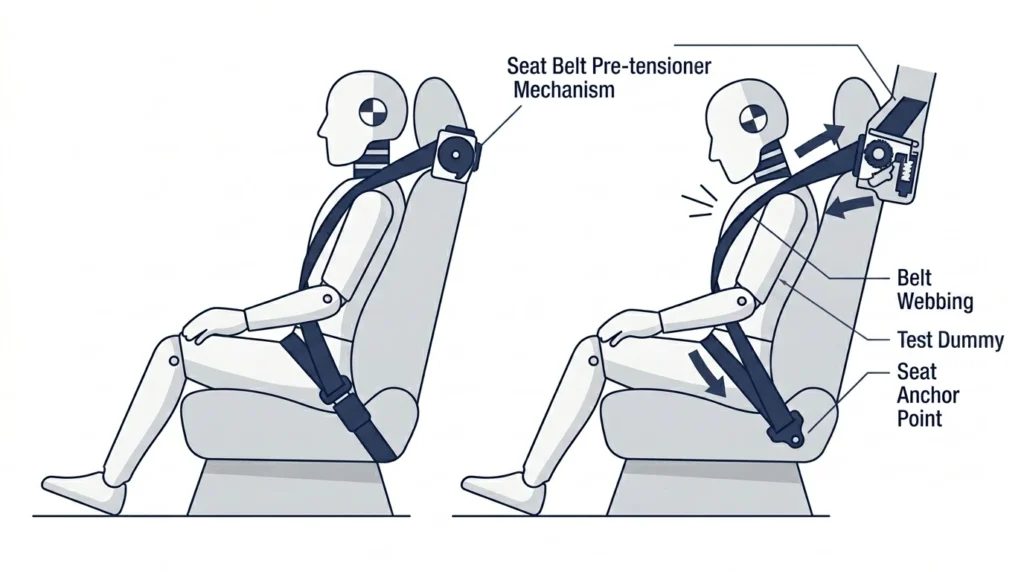
seat-belt-pre-tensioner-diagram.jpg
Illustration showing how a seat belt pre-tensioner works — rapidly retracting the belt webbing on impact to hold the occupant securely in position before collision forces take effect.
  1. Pre-tensioners: A device that rapidly tightens the seat belt within milliseconds of a collision, removing slack and pulling the occupant firmly into the seat and reducing forward movement and ensuring optimal airbag interaction.
  2. Load Limiters: A safety mechanism that allows a controlled amount of seat belt webbing to release after initial tensioning, reducing peak chest pressure and preventing seat belt-induced injuries during a crash.
  3. Inflatable Seat Belts: A belt fitted with a built-in airbag along the shoulder strap that deploys on impact, spreading crash forces across a wider area of the torso to reduce pressure and protect the head and neck.
  4. Active Seat Belts: A belt integrated with advanced driver-assistance systems (ADAS) that can vibrate or tighten to warn drivers of hazards, and automatically pre-tension before an unavoidable collision to prepare the occupant for impact.
  5. Four-Point and Five-Point Harnesses: A multi-anchor restraint system that distributes crash forces across more points of the body than a standard three-point belt to offer superior protection, commonly used in performance and racing vehicles.

Why Are Seat Belt Extenders Still Necessary?

Despite advances in seat belt technology, extenders remain essential because innovations focus on crash performance and not belt length or accessibility. Standard seat belts are still designed around a limited size range, yet according to NHS England’s Health Survey for England 2024, 66% of UK adults are either overweight or living with obesity, meaning the majority of drivers may struggle with a standard fit. This leaves many passengers without a safe and comfortable fit when they don’t have an extender.

pregnant-driver-seat-belt-extender-positioning.jpg
A seat belt extender helps pregnant drivers position the lap belt safely below the abdomen, protecting both mother and baby during every journey.
  • Specific vehicle designs: Some vehicles, regardless of advanced safety features, may still have buckle designs or placements that benefit from an extender for optimal comfort and ease of use.
  • Plus-size individuals: As long as standard seat belt lengths remain finite, extenders will be necessary to ensure a comfortable and safe fit for larger occupants.
  • Pregnant individuals: The need to position the lap belt correctly below the abdomen makes extenders a valuable tool for expectant mothers throughout pregnancy.
  • Individuals with mobility challenges: For those with limited flexibility or dexterity, extenders provide easier access to recessed buckles, thus promoting consistent seat belt usage.

What Does the Future Hold for Seat Belt Extenders?

Future seat belt extenders are likely to become smarter and better integrated with vehicle safety systems, and more standardised across manufacturers. As automotive technology evolves, extenders will adapt. They’ll move from simple mechanical add-ons to intelligent components that communicate with a vehicle’s onboard safety systems.

  • Enhanced materials: Ongoing research into lightweight, high-strength materials could lead to even more robust and discreet extender designs.
  • Smarter extenders: Future extenders might incorporate sensors that communicate with the vehicle’s safety systems, ensuring they are correctly installed and do not interfere with pre-tensioners or load limiters.
  • Integrated solutions: Car manufacturers might offer more factory-integrated adjustable seat belt options or extenders as standard or optional equipment. This acknowledges the diverse needs of their customer base.
  • Standardisation: Greater standardisation of buckle types across the industry could simplify compatibility, making it easier for consumers to find suitable extenders.

Takeaway

The landscape of automotive safety is constantly innovating, with seat belt technology at the forefront. While these advancements make vehicles safer than ever, the simple yet effective seat belt extender will continue to be an indispensable device. It bridges the gap between standard design and individual needs, ensuring that everyone can benefit from the life-saving protection of a properly fitted seat belt. As extenders evolve alongside new vehicle technologies, their core mission stays the same: making every journey safer and more comfortable for everyone.

Ready to find the right fit? Browse our range of UK-tested seat belt extenders, which are compatible with most cars and available with free Royal Mail delivery. We believe safety should never be one-size-fits-all.